
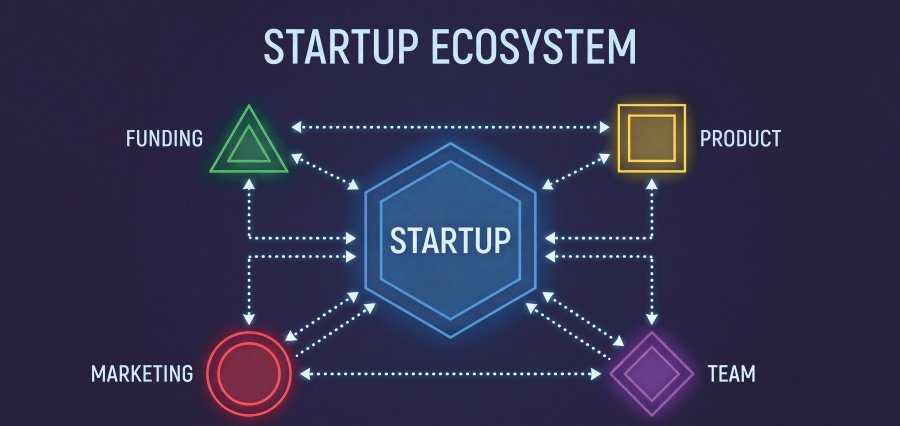
The journey of building a startup begins long before the product is launched or revenue is generated. It starts with understanding the environment in which a business grows, collaborates, and thrives. Many aspiring founders often ask what is startup ecosystem, as it forms the foundation of every successful venture. Alongside this, one of the most critical challenges entrepreneurs face is learning how to raise funds for a startup in a competitive and ever-evolving market.
The Foundation Of A Thriving Startup Ecosystem
To truly grasp what is startup ecosystem, one must look at the interconnected network of people, institutions, and resources that support entrepreneurial growth. This ecosystem includes founders, investors, mentors, accelerators, incubators, and even government policies that encourage innovation. Each component plays a vital role in shaping how startups are built and scaled.
A strong ecosystem creates opportunities for collaboration and knowledge sharing. It allows entrepreneurs to learn from each other’s successes and failures, reducing the risks associated with starting a business. Cities like Bengaluru, Silicon Valley, and Tel Aviv have become global hubs because they offer access to talent, capital, and mentorship, all within a supportive framework.
At its core, the answer to what is startup ecosystem lies in its ability to nurture ideas into viable businesses. It provides not just financial backing but also emotional and strategic support, which is equally important in the early stages of a startup journey.
Key Players That Drive Startup Growth And Innovation
Every startup ecosystem thrives on the strength of its participants. Founders bring ideas to life, while investors provide the capital needed to scale those ideas. Mentors and advisors guide entrepreneurs through complex decisions, helping them avoid common pitfalls.
Accelerators and incubators play a significant role in early-stage development. They offer structured programs, access to networks, and sometimes initial funding. Governments also contribute by creating policies that make it easier to start and run businesses, such as tax benefits and simplified regulations.
Understanding what is startup ecosystem also means recognizing the importance of customers and markets. Without demand, even the most innovative ideas fail to sustain. Media and educational institutions further amplify the ecosystem by spreading awareness and building entrepreneurial skills.
This interconnected web ensures that startups do not operate in isolation but are part of a larger, dynamic environment that continuously evolves.
Practical Strategies On How To Raise Funds For A Startup
One of the most pressing concerns for any entrepreneur is how to raise funds for a startup. Funding is essential for product development, marketing, hiring, and scaling operations. However, securing investment requires more than just a great idea.
The first step is to build a strong business plan. Investors need clarity on the problem being solved, the target market, and the revenue model. A compelling pitch deck can make a significant difference in attracting attention. Networking is equally crucial, as many funding opportunities come through connections rather than cold outreach.
There are multiple funding options available. Bootstrapping allows founders to use personal savings, giving them full control over the business. Angel investors provide early-stage funding in exchange for equity, while venture capital firms invest larger amounts in high-growth startups. Crowdfunding has also emerged as a popular alternative, enabling entrepreneurs to raise small amounts from a large number of people.
When exploring how to raise funds for a startup, timing is critical. Raising funds too early or too late can impact growth. Entrepreneurs must also be prepared for rejection and use feedback to refine their approach.
Balancing Growth, Sustainability And Long Term Vision
While funding and ecosystem support are essential, long-term success depends on how well a startup balances growth with sustainability. Rapid expansion without a clear strategy can lead to operational challenges, while slow growth may result in missed opportunities.
A well-functioning ecosystem helps startups navigate these challenges by providing access to experienced mentors and industry insights. Founders must focus on building a strong team, maintaining financial discipline, and continuously innovating to stay relevant.
Understanding what is startup ecosystem also involves recognizing its role in fostering resilience. Startups often face uncertainty, and being part of a supportive network can make a significant difference. Similarly, mastering how to raise funds for a startup is not a one-time effort but an ongoing process that evolves with the business.
Building Momentum And Creating Lasting Impact In Startup Journeys
The true essence of entrepreneurship lies in creating value that extends beyond profits. Startups have the potential to solve real-world problems, generate employment, and drive economic growth. By understanding what is startup ecosystem, founders can position themselves within a network that amplifies their impact.
At the same time, knowing how to raise funds for a startup empowers entrepreneurs to turn their vision into reality. It enables them to access the resources needed to innovate, scale, and compete on a global stage.
As more individuals embrace entrepreneurship, the importance of strong ecosystems and effective funding strategies will only continue to grow. The journey may be challenging, but with the right knowledge and support, startups can transform ideas into lasting success stories.