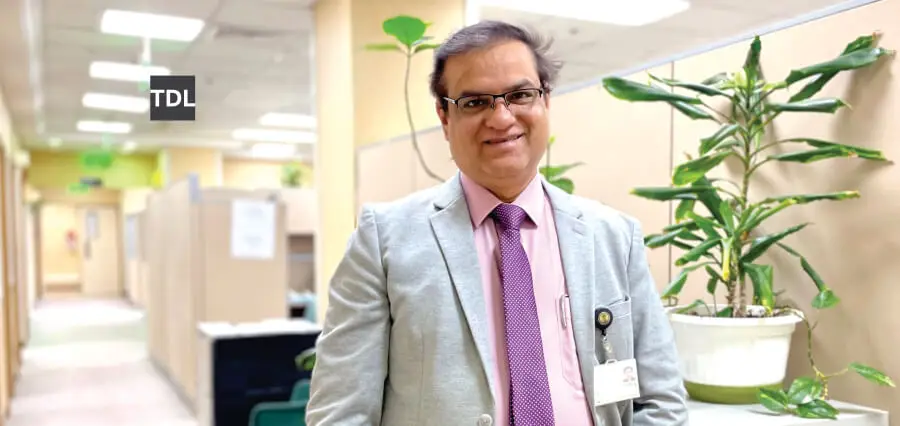
Some careers begin with a clear objective in mind; others evolve through curiosity, continued learning, and adaptability. Dr. Mansoor Ali Yusuf Baig’s career exemplifies the latter. At first, he had no plans to become a leader in healthcare technology. His career started with web & Graphic designing in the mid-1990s, when the internet was transitioning from an academic platform to a rapidly expanding commercial environment. He handled technology differently as a result of his early exposure to design and human interface. He found that every system should be seen from the user’s perspective. Decades later, he is known to be one of the prominent enterprise Digital Transformation and AI Strategist / Expert, widely recognized in the realm of Healthcare Research in Saudi Arabia and beyond, and handled various roles as Senior Technical Specialist, Head of Scientific Computing, and Digital Information Orchestrator at King Faisal Specialist Hospital and Research Centre (KFSHRC), that concept continues to influence his work.
He is currently affiliated with King Faisal Specialist Hospital and Research Centre, Global Alliance for Artificial Intelligence (GAFAI) and American College of Health Data Management: (ACHDM) as a fellow, leading some critical AI initiatives in the region pertaining to Enterprise AI Adoption, Enterprise Digital Transformation and AI Governance.
Dr. Mansoor now connects cutting-edge computing with pertinent clinical outcomes. He develops technologies that help researchers transform disorganized medical records into data that is useful, structured, and prepared for artificial intelligence. He also establishes registries and registry-based systems that make it easier to trace patients, diseases, trials and medical devices across national health systems. His work demonstrates a deeper comprehension of technology as a tool for improved research, stronger healthcare systems, and better patient outcomes.
Service as the Foundation
Dr. Mansoor identifies three core convictions that have shaped his leadership. He views professional challenges as opportunities to learn rather than threats. He sees obstacles as opportunities for his team to grow and develop. He also considers credibility dependent on understanding the full technology stack, rather than simply directing people with technical expertise. Most importantly, he sees technology leadership in healthcare as an act of service that supports researchers, clinicians, and the patients represented by every data point.
He continues to lead in the way he first learned, by observing, listening, and remaining a student. This humility shapes how he combines technical expertise with the human side of leadership. Scientific computing operates at the intersection of high-performance computing, multi-omics data, complex registries, and machine learning. The technical demands are significant. However, Dr. Mansoor considers technical expertise only the starting point of effective leadership. People ultimately deliver meaningful outcomes.
He sees himself as a translator between disciplines. He converts research goals into clear engineering requirements and explains engineering limitations in terms that scientists and clinicians can understand and apply. This ability to connect different perspectives helps build trust and strengthen collaboration across teams.
Dr. Mansoor remains close enough to the technical architecture to review designs with confidence while giving specialists ownership of their work. He encourages engineers to spend time with laboratory teams and researchers to strengthen their understanding of artificial intelligence. He considers empathy across disciplines essential to transforming a technically strong team into a people-centered one.
He also gives his team the confidence to experiment. Mistakes made during the learning process are treated as opportunities to develop capability rather than as failures. This approach creates an environment where people can learn, take ownership, and grow while continuing to deliver meaningful results.
Leading Through Technology
When complex decisions meet rapid technological change, Dr. Mansoor relies on a clear set of guiding principles. His first principle is to put fundamentals before ambition. Amid the current enthusiasm around artificial intelligence, he believes data strategy, governance, integration, and digitization must come first. A strong foundation helps distinguish meaningful transformation from experimentation. He points to industry research showing consistently high failure rates among enterprise AI initiatives and notes that many failures can be traced to weak foundations rather than weak algorithms.
His second principle is measurable value. Every initiative should be linked to a defined outcome. He favors small, structured steps with clear checkpoints before an initiative is scaled. His third principle is that ethics and human oversight are essential. Technology can support healthcare decisions, but it should never replace the human judgment behind them.
When facing uncertainty, he applies the risk management discipline developed through years of project management. He identifies potential problems early, prepares contingency plans, and keeps stakeholders informed through honest communication. Across every decision, he places evidence above hype.
Innovation Guided by Discipline
Innovation, in Dr. Mansoor’s approach, requires both freedom and structure. He gives his teams the space to explore emerging technologies, develop prototypes, and question established methods. However, every promising idea must then go through a disciplined evaluation process. Teams begin with a small and focused pilot that has clear success criteria. The solution is tested against real research or operational needs before any wider implementation.
This approach ensures that promising ideas are not left as concepts and that untested solutions do not enter production. When a pilot succeeds, the team identifies elements that can be reused. These may include data pipelines, integration components, or monitoring practices. Each successful project can then strengthen the broader technology platform rather than become another isolated system.
The disease and device registries developed by his team provide a clear example. What began as creative solutions to data capture challenges developed into quality-assured repositories through disciplined engineering. They now serve as AI-ready data sources. For Dr. Mansoor, creativity opens the door to innovation, but discipline turns an idea into something practical, reliable, and lasting.
Empowering Through Mentorship
Mentorship has been an important part of Dr. Mansoor’s career. He has guided students, interns, and working professionals in software development, machine learning, enterprise artificial intelligence, and solution design. He considers this work among the most meaningful parts of his career.
His approach focuses on giving people ownership of outcomes rather than assigning isolated tasks. When a team member takes responsibility for a registry, platform, or pipeline from start to finish, that person develops sound judgment along with technical skills.
He combines ownership with structured support. This includes supervised sprints, opportunities to work across different systems, and honest reviews that focus on the work rather than the individual. He also encourages team members to present their work directly to stakeholders. He believes confidence grows through experience and visibility.
Creating a safe environment is equally important to his approach. He encourages team members to acknowledge when they do not know something and treats psychological safety as an essential foundation for learning and development. By sharing institutional knowledge and turning experience into repeatable learning, he helps the next generation build their skills with greater confidence and a stronger foundation.
The Power of Lifelong Learning
Dr. Mansoor believes learning happens everywhere, not only in classrooms or laboratories. His academic and professional development reflects this commitment. He holds a PhD in Computer Science, a Master’s in Information Technology, and an MBA in Project Management. His qualifications also include the Certified AI Professional credential from GAQM, training in AI governance, risk, and compliance aligned with ISO/IEC 42001, PMP certification, and several Microsoft credentials.
He also holds a Fellowship from the American College of Health Data Management and serves as a reviewer for international journals and conferences focused on medical informatics, healthcare systems, digital solutions, machine learning, and artificial intelligence. He encourages the same commitment to learning within his team. He supports dedicated time for exploration and prototyping, journal reviews, cross-training between engineering and research roles, and learning goals connected to meaningful institutional outcomes.
Technology cycles that once took years can now change within months. Dr. Mansoor believes the sustainable response is to make continuous learning part of everyday work. He leads by example and demonstrates that professional growth should remain an ongoing part of effective leadership.
Resilience Through Change
Every career includes moments that reshape how a person understands resilience. For Dr. Mansoor, one such moment followed a series of technically sound projects that did not deliver the expected outcomes. The systems worked, and the analytics were effective, but adoption remained limited. The experience showed him that technology alone could not address every challenge.
Rather than view the projects as failures, he examined why they had fallen short. He concluded that sustainable impact requires a broader socio-technical approach. This includes data strategy, governance, workflow integration, user trust, and change management. These elements must work together rather than operate in isolation.
This insight later influenced the Digital Transformation and AI strategy he developed for Research and Innovation at KFSHRC. The strategy approached transformation as one integrated program rather than a series of disconnected deployments. For Dr. Mansoor, resilience is not simply about enduring setbacks. It is about understanding the lessons they provide and using those lessons to build better systems.
Engineering Lasting Impact
Dr. Mansoor points to one project as a strong example of his ability to turn complex challenges into meaningful results. It was the national initiative called Comprehensive implantable medical device registry, delivered through a United Nations Development Programme engagement on behalf of the Saudi Food and Drug Authority. The project presented significant challenges. It required a national-scale system, coordination among multiple stakeholders, and the management of highly sensitive data. There was also no existing model to follow.
Drawing on his years of Registries/Digital solutions/Research & Innovation Databases and data experience at KFSHRC, he and his team designed and delivered a platform that can operate nationally across the Kingdom. This achievement is part of a broader body of work. He contributed to the development of the national cancer registry with the Saudi Health Council. He has also designed and maintained more than fifteen custom disease and device registries while supporting six national health programs.
Each project presented its own complexities. Yet these challenges became opportunities to create lasting infrastructure through careful planning, stakeholder alignment, and disciplined engineering. For Dr. Mansoor, these experiences demonstrate that the most difficult challenges in healthcare technology are rarely purely technical. They also require collaboration, patience, trust, and a clear understanding of the people and systems the technology is designed to serve.
Advice for the Next Generation
For professionals who want to build careers with meaningful impact, Dr. Mansoor offers a clear and practical approach. He emphasizes the importance of mastering the fundamentals before pursuing trends. Professionals who understand how systems work are better prepared to adapt as technologies and frameworks change.
For those entering healthcare technology, he recommends developing a strong understanding of data. Well-curated data provides the foundation for artificial intelligence and other advanced technologies. He also encourages professionals to make continuous learning part of their daily lives. Skills can become outdated quickly, making adaptability an essential capability for the future.
He expects fields such as data science, machine learning, cybersecurity, and bioinformatics to remain important. However, he sees the strongest advantage in combining technical knowledge with a deep understanding of a specific field. Professionals who can connect domain expertise with technical skills will be better positioned to create meaningful solutions.
His final advice is to lead with purpose and patience. Meaningful progress in healthcare is measured over years and through patient outcomes, not quarterly results. He encourages professionals to remain humble, observe those around them, learn from every challenge, and remember that technology should serve humanity rather than the other way around.
Building a Lasting Legacy
Looking ahead, Dr. Mansoor hopes to be remembered as an AI enabler within his organization and the wider field. He hopes the systems he has developed will continue to create value long after today’s technologies have changed. These include AI-ready research data platforms, registries that have transformed scattered records into valuable data sources, and the digital transformation framework he developed. He sees these systems as lasting foundations for future innovation.
He recognizes that technology changes quickly. Code may become outdated, but well-designed systems and the culture that supports them can endure. The legacy he values most, however, is measured through people. The students, interns, and professionals he has mentored carry forward more than technical knowledge. They also carry a way of working those places fundamentals before trends, values evidence over hype, and views technology as a tool for improving care.
If the next generation can build on this foundation and create an environment where advanced technology supports the mission of healthcare, he will consider his work meaningful. His journey from a young designer in the 1990s to an expert digital transformation and AI strategist / International healthcare AI architect/strategist/expert reflects a career shaped by learning, service, and a commitment to building systems that serve a greater purpose.