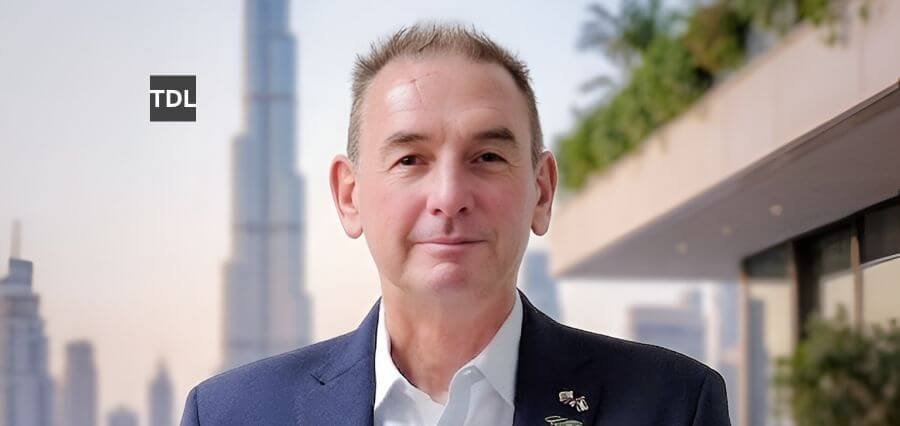
The path that led Darren Williams to his current position developed through his childhood at sea, where he practiced discipline as a way of life. At the age of 16, he joined the Royal Navy, which required him to exchange his secure life for hardships that would lead to his personal development. The organization required workers to execute their tasks with exactness, which established the fundamental principles that governed his approach to leadership development.
The initial period of his life showed the need for strength, which supported his leadership style because he understood that leadership involves duty, which should be executed through trust-based actions. The lessons he absorbed, embracing uncertainty, relying on collective strength, and focusing on solutions, became enduring principles that would guide him far beyond his military career.
Williams operates as General Manager at Grako LLC while maintaining his original purpose, which he developed during his youth. His method combines strategic planning with tactical implementation, which he executes through compassionate leadership and deep-seated appreciation for others. He has remained dedicated to his central idea that organizations require trust and dedication from people to achieve long-term success through his ability to handle global changes, personal difficulties and operational challenges.
Discover how purpose-driven leadership can transform challenges into lasting success.
A Journey That Began at Sea
Williams was sixteen years old when he packed his bags and left home to join the Royal Navy. He carried no grand blueprint, only a readiness to work hard and learn. That single act of courage meant stepping away from the familiar before most young people have settled in a direction; it set the tone for everything that followed.
The Royal Navy is not an environment that tolerates complacency. It demands precision under pressure, collective discipline, and an understanding that individual performance is inseparable from the safety and success of those around you. He absorbed all of it. He progressed steadily through the military leadership pathway, accumulating not just rank and skill but a philosophy of leadership that he still carries today.
“Teamwork” is a word that can lose weight through overuse, but for him it carries genuine meaning forged in operational reality. He came to understand, early and concretely, that success is never an individual pursuit. It is the product of collective trust, shared standards, and people pulling consistently in the same direction. The exceptional leaders he encountered along the way reinforced this, not through speeches, but through the daily practice of professionalism, humility, and commitment to the people they led.
That formative military chapter did not simply give him a résumé. It gave him a framework for how leadership works and why it matters. Everything since has been an extension of that foundation.
Three Principles That Outlasted a Career in Uniform
When Williams reflects on the milestones that shaped his leadership philosophy, he returns not to a single dramatic turning point but to three deceptively simple principles that he identified early and has never abandoned.
The first is the willingness to say yes, even when the path ahead is not fully visible. Throughout his career, he accepted assignments and opportunities that carried uncertainty. Rather than waiting for perfect conditions, he stepped forward and figured things out as he went. That habit of embracing the unfamiliar growth generated by staying within his comfort zone would never have been produced.
The second principle is the courage to ask for help. In environments that prize self-sufficiency, admitting that you need support can feel like weakness. He learned to see it differently. Seeking assistance is not a concession of inadequacy; it is a recognition that progress strengthens through collaboration. Leaders who ask questions and invite input to move faster and build better than those who work in isolation.
“Sustainable growth is less about rigid plans and more about maintaining focus, flexibility, and resilience as circumstances evolve,” he says.
The third principle is a solution-focused mindset. He understood that problems are inevitable. What distinguishes high-performing teams is not the absence of difficulty but the habit of framing challenges constructively by walking into a conversation with an idea rather than just a complaint. He observed that leaders are best supported when discussions move towards resolution rather than circling grievances.
Together, these three principles- say yes, seek help, and focus on solutions form the quiet architecture behind his approach to responsibility and continuous improvement. They are not abstract values he inherited. They are practices he tested, refined, and now actively encourages within every team he leads.
Strategy Meets Reality: Leading Through Constant Change
As a General Manager, Williams leads GRAKO LLC, the UAE-based organization established in 2004. The role sits at the intersection of long-term strategic thinking and the demanding, often unpredictable realities of day-to-day operations. He is candid about which of those two dimensions presents the greater challenge.
“Setting vision and long-term objectives is comparatively straightforward. Translating that vision into consistent execution, while simultaneously responding to rapidly shifting conditions, is where leadership truly earns its keep,” he notes. The COVID-19 pandemic illustrated this in the starkest possible terms. Global security disruptions reinforced the lesson. Both demanded that leaders hold their strategic direction firmly in mind while remaining genuinely adaptable in the present moment.
“Change is no longer an exception that organizations prepare for. It is the baseline condition in which they operate,” he argues. The leaders and businesses that thrive are not those with the most detailed plans, but those with the clarity to maintain focus and the flexibility to adjust when circumstances demand it. Resilience, in his view, is not a personality trait it is an organizational capability that must be built deliberately over time.
What Separates Exceptional from Good
Ask Williams what distinguishes an exceptional general manager from a merely good one, and he does not reach for the expected answers like analytical horsepower, strategic instincts, or an appetite for bold decisions. Instead, he points to empathy and emotional intelligence.
These qualities determine everything that follows. “A leader who genuinely understands the people around them, who reads not just what someone says but what they need, builds relationships that are qualitatively different from those forged through transactions and hierarchy alone,” he says. The most successful businesses, in his experience, are those grounded in genuine partnership, where trust accumulates over time and collaboration becomes a natural reflex rather than a forced exercise.
In such environments, relationships transcend the transactional. They are rooted in mutual respect and have a shared sense of purpose. That may sound idealistic, but he offers it as an observation drawn from direct experience, not as an aspiration but as observed reality within high-functioning teams.
Cancer, COVID, and the Test That Defined a Leader
Every leader face adversity. Fewer face it in the form that Williams encountered during one of the most demanding projects of his career. While overseeing a team of height-safety specialists delivering EXPO 2020 Dubai, he received a cancer diagnosis. He underwent chemotherapy and radiotherapy, treatments that would have justified stepping back. He did it all while continuing to lead his team through a global pandemic that had turned every operational assumption on its head.
“Trust creates the space to be open, remain accountable, and accept constructive challenges, it is not a principle for good times only,” he expresses.
The experience did not simply test his resilience. It crystallized, with uncommon clarity, why the leadership principles he had spent a career building actually matter. Trust has become not a management concept but a practical necessity. Open communication was not a cultural aspiration but the mechanism through which work continued to happen. His ability to rely on the people around him and their ability to rely on him, kept everything moving.
He reflects on that period with characteristic understatement, describing it as a powerful reminder that sustained success is only possible when leaders genuinely trust their teams and enable them to step forward together. The lesson, earned under conditions most people will never face, remains central to how he leads today.
The Case Against Micromanagement
When asked to name a transformative initiative that reflects his impact as a leader, Williams resists the temptation to claim credit for a bold strategic move or a landmark restructuring. He identifies something he considers far more important: the practice of trusting teams to find their own way.
“Micromanagement is not just inefficient; it is actively harmful to the people it purports to supervise. It signals a fundamental distrust that erodes confidence and stunts capability,” he believes. He takes a different approach. He creates conditions in which his teams have the freedom to make decisions, the accountability to own those decisions, and the assurance of support when things do not go as planned.
Mistakes, which he is quick to acknowledge, are inevitable. They are also essential. A team that never makes mistakes is a team that never takes initiative, never innovates, and never grows. The leader’s role in those moments is not to take control but to remain present, offer guidance without overriding, and support the process of learning rather than by passing it. Confidence, capability, and accountability emerge naturally from that space.
It is a principal he has benefited from personally. Leaders who extended genuine trust and responsibility to him at different stages of his career contributed substantially to his development. He now carries that forward, not as a management technique but as a genuine belief in what people are capable of when given the room to discover it.
Technology with Purpose, Humanity at the Centre
GRAKO LLC operates in a world where digital transformation and artificial intelligence have moved from boardroom conversation to operational reality. Williams engages with both with what he describes as purposeful skepticism — not resistance to progress, but insistence that adoption be driven by clear benefit rather than perceived pressure.
His concern is with the tendency to introduce technology simply because it is available. Too many organizations, in his observation, implement digital solutions without fully examining their impact, suitability, or long-term value. The result is disruption without corresponding benefit, change for its own sake rather than transformation in service of a genuine goal. Meaningful modernization, as he sees it, requires careful analysis, consideration implementation, and an unwavering focus on outcomes.
That same principle extends to his broader concern for the future of leadership. As artificial intelligence, digital communication, and automated systems continue to expand their footprint in professional life, he worries about the erosion of the human element, the judgment, empathy, and genuine connection that no algorithm replicates. He invokes a reflection from Mark Colbourne MBE: “Inconsistency is woven into the fabric of being human. If everything made perfect sense, it wouldn’t be life; it would be a machine.”
It is a caution worth heeding. Remaining mindful of shared humanity staying humble, asking questions when uncertain, supporting one another through openness and patience is not nostalgia for a simpler era. He insists that it is an enduring virtue in any management or leadership approach, regardless of how the technological landscape shifts around it.
The Open Door and the Lasting Legacy
Darren Williams has led through military service, global pandemics, personal illness, and the daily complexity of running a high-performing organization in a competitive market. He has done so by keeping his attention fixed not on titles or accolades but on the people around him and the conditions he creates for them to thrive.
His door has always been open. There is never a wrong question, only occasionally the wrong moment to ask it. That posture of accessibility, patience, and respect is not incidental to his leadership; it is the practice through which trust accumulates, and teams develop the confidence to perform at their best.
The recognition of Outstanding General Manager of the Year in Saudi Arabia at GELA 2026 honors a career shaped by service, tested by adversity, and defined by an unwavering belief that meaningful achievement is always built together. For Williams, that belief is not philosophy. It is the operating principle behind everything he does, one that took root in the Royal Navy at the age of sixteen and has never stopped growing.